5 Ways to Source Reusable Grocery Bags in Bulk in 2026: A B2B Buying Guide
For supermarkets, retailers, promotional agencies, event organizers, and importers, sourcing reusable grocery bags in bulk is not only about finding the lowest unit price. The right purchasing strategy should balance material, durability, printing, MOQ, lead time, freight, and the number of times the bag is realistically expected to be reused.
Reusable grocery bags can be made from non-woven polypropylene, woven polypropylene, recycled PET, cotton, canvas, and other materials. Each option has a different cost structure and performance profile.
This 2026 guide explains five practical ways to control sourcing costs without using "cheap" as the purchasing standard.
Choose the Right Material for the Actual Use
Material selection is one of the biggest drivers of cost.
A bag designed for a one-day trade show does not need the same fabric weight or construction as a reusable supermarket bag carrying heavy groceries.
Common options include:
Non-Woven Polypropylene
Best for:
- Supermarkets
- Promotional campaigns
- Retail stores
- Trade shows
- General shopping
Main advantages:
- Lightweight
- Cost-efficient at scale
- Good printing surface
- Available in many colors
- Suitable for stitched or heat-sealed construction
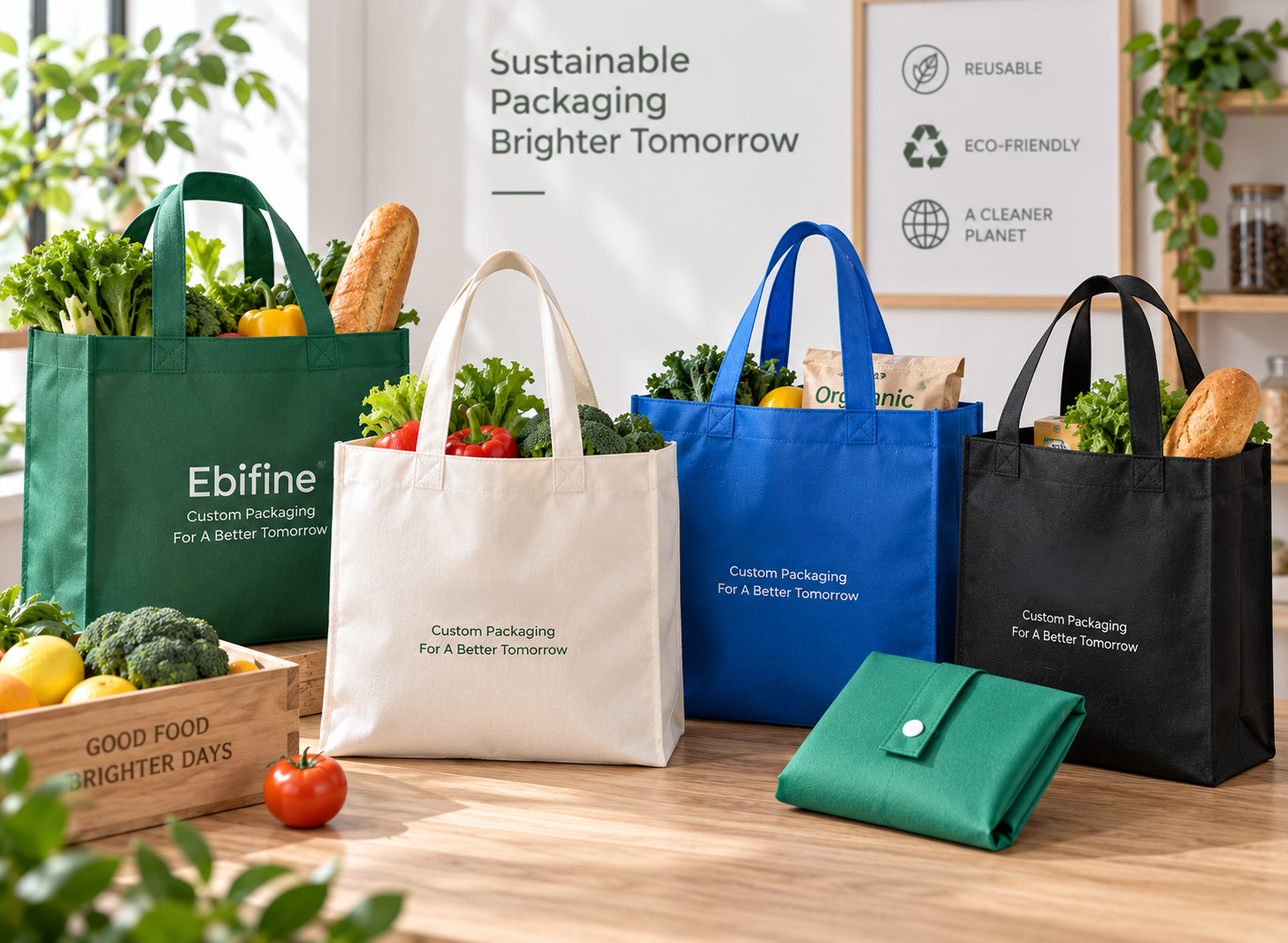
For buyers comparing custom specifications, Ebifine's non-woven bag solutions can be used as a starting point for GSM, size, printing, and handle options.
Woven Polypropylene
Best for:
- Heavy groceries
- Repeated retail use
- Large-capacity bags
- Laminated shopping bags
Main advantages:
- Stronger load-bearing performance
- Good dimensional stability
- Suitable for lamination
- Durable for repeated use
Cotton and Canvas
Best for:
- Premium retail
- Lifestyle brands
- Corporate gifting
- Long-term promotional merchandise
Main advantages:
- Premium hand feel
- Strong brand perception
- Suitable for embroidery and screen printing
- Good for higher-value campaigns
The main trade-off is cost. Cotton and canvas usually require more material and labor than basic non-woven PP bags.
Recycled PET
Best for:
- Brands prioritizing recycled-content messaging
- Retail programs
- Promotional shopping bags
- Lightweight reusable formats
Important sourcing note:
Ask for documentation supporting the claimed recycled content rather than relying only on marketing wording.
Match GSM, Size, and Construction to the Load
Over-specifying a bag increases cost. Under-specifying it increases failure risk.
For non-woven and woven bags, buyers should define:
- Width
- Height
- Gusset
- Handle width
- Handle length
- GSM
- Seam method
- Target load
- Intended number of reuses
A smaller 70–80 GSM promotional bag may be suitable for lightweight items, while heavier grocery applications may require higher GSM, reinforced handles, and stitched seams.
The best way to control cost is not to automatically choose the lightest material. It is to choose the lowest specification that still meets the real performance requirement.
Request a Load Test
Before a large order, ask the supplier to test:
- Handle attachment
- Side seams
- Bottom seam
- Gusset strength
- Repeated loading
A physical pre-production sample is much more useful than relying on a general statement such as "heavy duty."
Simplify Printing Without Weakening the Brand
Printing complexity can significantly affect unit cost.
For high-volume reusable grocery bags, simple artwork often provides the best balance between branding and budget.
Silk-Screen Printing
Best for:
- One or two colors
- Bold logos
- Large quantities
- Non-woven and canvas bags
Advantages:
- Cost-efficient
- Good color coverage
- Simple setup
- Suitable for strong brand marks
Heat Transfer Printing
Best for:
- Multi-color artwork
- Gradient designs
- Smaller detailed graphics
This option usually costs more than simple screen printing.
Laminated Full-Color Printing
Best for:
- Woven PP bags
- Premium grocery bags
- Edge-to-edge artwork
- Photographic designs
Laminated printing can create a stronger shelf presence but usually involves higher setup costs and MOQs.
Cost-Control Tips
- Use one or two print colors where possible
- Print one side instead of both sides when appropriate
- Avoid oversized print areas unless necessary
- Use stock bag colors that already match the brand
- Finalize artwork before sampling to reduce revision costs


Comments
Post a Comment